Showing posts with label fabric. Show all posts

Monday, 13 February 2017

Stitching Updates - some finishes

Since getting my stitching mojo back just before Christmas, I've finished off quite a few pieces, the patterns for which are all available from my Etsy store - follow the links below the images.  I'll let the photos speak for themselves. :)

Fantastic Beasts and Where to Find Them

Idris and the TARDIS

Juno

Tabletop.  This pattern isn't available on Etsy.  If you'd like it, let me know.

Hitchhiker's Guide to the Galaxy
Rugrats Families

Charmed Alphabet

Phew.

Happy stitching!

Friday, 25 March 2016

Stitching the A to Z Challenge - fabric prep

This blog was originally written to go up before the Challenge reveal post.  But then I moved into my new place (which was last minute because of furniture delivery dates) which took up a lot of my spare time, and I had no internet, which really affects the ability to upload blog posts!  

Now that I've chosen my fabrics (and patterns) for the A to Z challenge, it's time to get them ready.

I like to have a 10x10 grid on my fabric when I stitch.  I find that it helps me keep my place when counting, I can stitch a single colour rather than having to constantly change so I don't lose my place, and all in all there is less un-picking (or frogging as it's known).

Stitched 10x10 grid lines for the Supernatural Alphabet
I used to stitch the 10x10 grid, using long stitch (or just really long back stitch - usually 10 squares at a time.  I'd pick a contrasting colour (one that wasn't going to be stitched in the pattern) and go for it.  It would take me a good few hours depending on the size of the pattern, but I always figured it would save me time in the long run.  My favourite part at the end of a long stitching project was pulling out the grid lines - hoping that I hadn't managed to stitch through the thread, making it a lot more difficult to remove.
The drawn 10x10 grid for the Pokemon Pattern
These days I use a wash-out fabric pen.  It is so much quicker!  A table/flat surface, the pen, the fabric, a ruler... and within about 15 minutes the job is done.  The pen I use is from a quilting store (it doesn't have the brand name written on it!) - it washes out in cold water, or air-fades in about 30 days.... which can mean you have to redraw the lines if your project is a bigger, or takes you longer to stitch... but totally worth it!  Just make sure you test it out on a corner of your fabric first - the last thing you want is to get to the end of your project and discover that the particular pen you're using doesn't wash out of your particular fabric!

When I was drawing up my fabrics a couple of days ago, I was using a fine-point one.  I thought "oh, this will be neater, less bleeding".  Slight problem - it faded within about an hour! Where I'd drawn the lines a bit thicker it was still (slightly) visible, but predominately there wasn't a trace.  I don't know whether it was because it was particularly humid that day, or particularly sunny... whatever the reason, I had to redo the whole thing with one of my older pens.  Oh well - you live and learn I guess!  I also had to stitch the grid-line onto the Supernatural pattern - the fabric just seemed to absorb the ink, and with the darker colour it wasn't really showing up.

Next I'm going to stitch the background lines.  The Pokemon pattern I've chosen has dividing lines between the letters so I'm stitching these ahead of time - to save me time during the challenge, and to help with the counting.

I've changed the colours a bit from the original pattern.  It always amuses me when I'm stitching one of my own projects and think "I don't like that colour choice, I'm going to change it."  I'm the one who came up with it in the first place, you'd think I'd be happy with it!  Oh well, colour choices/preferences change with time, and it really can depend on the fabric colours too.  Again - the joys of cross stitch - it's open to change to suit individual preferences.

How's your A-Z prep going?

Happy stitching!

Wednesday, 17 June 2015

WIP Wednesday

This week I've started work test stitching a new pattern!  This one has been in the design stages for almost a year but I finally managed to finish the pattern last week with a bit of input from a couple of friends.

I started the piece on Friday, and this is where I've gotten to today:
I'm stitching this on "Rose Garden" 14 count aida from Sew It All
Not the fastest of stitching, but I've been working on a few other new patterns as well - which is why they take so long to design - I keep distracting myself!  On that note, stay tuned - I've added several new patterns to my Etsy store and will be detailing them in full over the next few blog posts.

Any guesses as to what this one might be? ;)

Happy Stitching!

Sunday, 18 January 2015

How to Cross Stitch - The Essential Materials

Cross stitching has long been my favourite hobby- I love how relaxing it is, how I can tune out the world around me, and I especially love sharing my hobby with others.   It is a very simple skill to pick up, as my 27 year old brother demonstrated last week when he stitched his first ever piece as a present for his girlfriend.
My brother's first stitching project.
Pattern is from a World Of Cross Stitch magazine
Several people have recently asked me via Etsy how difficult it is to learn how to stitch and so I thought I would put together a bit of a "how to" guide.

As I started putting this blog post together, it became bigger than Ben Hurr, so I decided to break it down into different posts.  As I write each one, I'll update the links here:
- The essential materials
- Starting Off
- The Cross Stitch
- The Back Stitch
- The Half Stitch
- The French Knot
- Beading (from last week)
- Stitching on Evenweave

This week is
The Essential Materials

The Thread

Cross stitch thread comes in bundles known as skeins.  It is a long length of thread, made up of 6 individual strands.  Most stitches require either one or two strands of thread to work the design.  Two threads gives a thicker appearance and covers the fabric better.  One strand tends to be used for backstitch.  I store my threads on bobbins to keep them organised so I can find the desired number quickly, and to stop them becoming tangled.


There are many different brands of cross stitch thread, however the main ones are DMC and Anchor.  I tend to use DMC as that is what my mother was collecting when I inherited her stash


To start stitching, unwind the desired length of thread from the skein or bobbin and cut it off.  I like to have a length about as long as my arm so that I don't have to come back for more as often.  However, shorter lengths do not become as tangled.  If you are new to cross stitch, a length approximately 20 to 30 cm is a good place to start.
The Fabric

There are many different types of cross stitch fabric around - aida, cotton evenweave, linen, zweigart linda, hardanger, crewel, plastic canvas, stitching paper... the list is endless.  They come in a multitude of colours and sizes and everyone has their own preference.  There is a great description on some of the different types of fabrics here.

The main types I use are aida and evenweave.

Aida is woven into blocks, which creates squares for you to stitch over.  Because it is so easy to see the squares, it is an ideal fabric for the beginner stitcher.  It comes in different sizes - 6, 8, 10, 12, 14, 16, 18.  These sizes relate to the number of squares per inch - the bigger the number, the smaller the squares on the fabric.

 Evenweave contains lots of strands of flax.  It tends to be more uneven than aida.  The holes in the fabric are smaller, and stitches are made over two strands or holes rather than one. Evenweave sizes (22, 24, 26, 28, 32 holes per inch) tend to be double that of aida - for example 14 count aida is approximate to 28 count evenweave.

The Needles

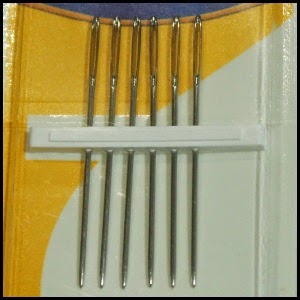
Needles used in embroidery are blunter than those used for general sewing.  Because the holes are already present in the fabric, you don't need a very sharp needle to push through.  Tapestry needles also have large eyes, which makes it easier to thread them.  Needles come in a variety of sizes depending on how thick they are.  The larger count fabric you are using (remember - smaller holes), the thinner needle you should use so you don't stretch out your fabric.  I came across a really handy guide here that discusses the correlation of needle and fabric size for cross stitching.


The Scissors


It is important to have a sharp pair of embroidery scissors when stitching.  And that they aren't used for anything other than cutting threads or fabric!  Paper will blunt your scissors pretty quickly.


The Hoop


I find it essential when stitching to use a hoop or frame.  This helps keep the fabric taught which means that your stitches are more even.  It also gives you something to hold on to rather than your fabric, reducing the stains caused by the oils in your sweat and any dirt on your fingers.

My favourite frame at the moment is the Q-Snap frame.  It comes in a range of sizes that can be joined together to create even more sizes and shapes, and doesn't squish my stitches as much as a hoop does.

The Measuring Tape


Essential for measuring out your fabric prior to using it - so that you know you have enough before you start stitching.

(Plus he's just so cute I had to include him!)


Coming up...


Over the next few weeks, I will show you some the main stitches involved in cross stitch, including the cross, the backstitch, the half stitch, and the dreaded french knot.  I'll also show you how to stitch on evenweave, which is my preferred stitching fabric.

Happy Stitching!